
AII Knowledge Center › Educational Article
Vented vs. Non-Vented IV Tubing: What’s the Difference?
Vented and non-vented IV administration sets may appear similar, but they are designed to work with different types of fluid containers. Understanding the difference can help clinicians select compatible equipment, maintain consistent fluid flow, and troubleshoot avoidable infusion interruptions.
Published September 2026
Approximately 5 minutes to read
Listen to this Education Article
Prefer audio? Listen to the audio version of this Educational Article
Vented vs. Non-Vented IV Tubing: What’s the Difference?
Approximately 7 minutes
The written article and references below remain the complete version of this Educational Article.
IV administration tubing provides the pathway through which medication or fluid moves from its container toward the patient. However, not every administration set manages air in the same way.
The primary difference between vented and non-vented IV tubing is whether the administration set contains a pathway that allows replacement air to enter the fluid container.
Whether that pathway is needed depends largely on the type of container being used.
Why the Container Matters
Infusion containers generally fall into two broad categories: collapsible and non-collapsible.
Flexible IV bags are collapsible. As fluid leaves the bag, its walls move inward and the bag becomes progressively flatter. Because the internal volume decreases along with the fluid level, outside air ordinarily does not need to enter the bag.
Rigid glass bottles and many semirigid plastic bottles behave differently. Their walls do not collapse sufficiently as fluid leaves. A pathway for replacement air is therefore needed to prevent increasing negative pressure inside the container.
This creates the basic distinction:
Non-vented tubing is ordinarily used with flexible, collapsible IV bags.
Vented tubing is commonly used with rigid glass or semirigid plastic bottles that require replacement air.
Some vented administration sets are described as universal because their vent can be opened or closed depending on the container being used. Always confirm the intended use of the specific set rather than relying only on its appearance.
What Is Vented IV Tubing?
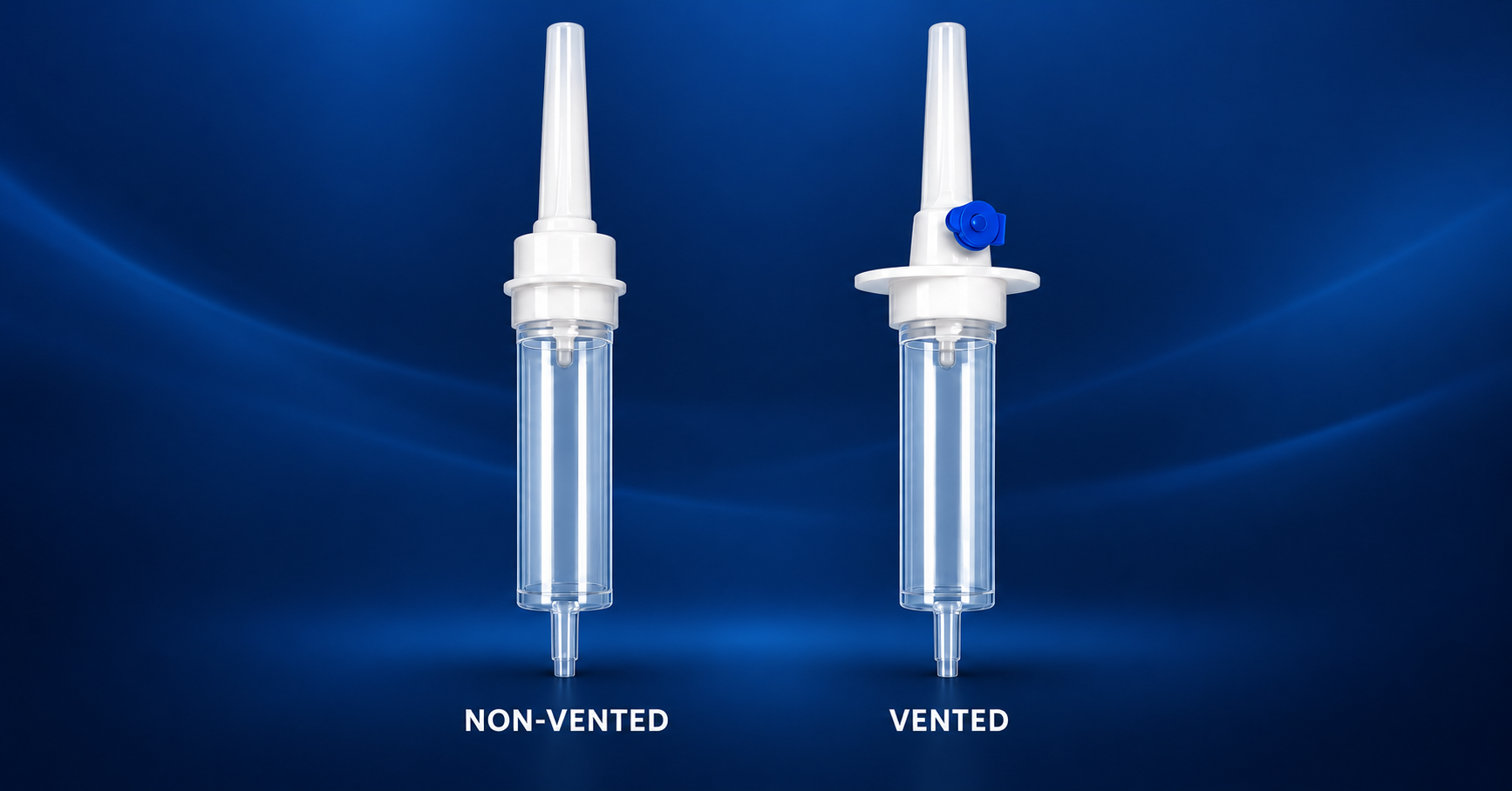
A vented administration set includes an air-inlet pathway, typically located near the spike above the drip chamber.
The spike provides a pathway for fluid to leave the container. The vent provides a separate pathway through which replacement air can enter. When used with a compatible rigid bottle, the vent is opened at the appropriate point in the setup process so air can enter as fluid flows out.
The two pathways perform different functions:
The fluid pathway carries medication from the bottle into the drip chamber and administration tubing.
The venting pathway allows replacement air to enter the container.
When the vent is functioning as intended, it helps maintain the pressure balance required for continued fluid delivery from a non-collapsible container.
What Is Non-Vented IV Tubing?
A non-vented administration set does not contain an integrated air-inlet pathway for the fluid container.
This design is appropriate for flexible IV bags because the bag collapses as it empties. The change in the bag’s shape replaces the volume previously occupied by the fluid, so outside air does not ordinarily need to enter.
However, non-vented tubing alone may not support consistent flow from a rigid bottle. As medication leaves the bottle, negative pressure can develop because the container cannot collapse and the tubing does not provide a route for replacement air.
When non-vented tubing is used with a rigid container, a separate compatible venting device may be required. In that configuration, the administration spike provides the fluid pathway and the separate device provides the replacement-air pathway.
At-a-Glance Comparison
Vented IV tubing
Includes an integrated air-inlet pathway
Commonly used with rigid glass or semirigid plastic bottles
Allows replacement air to enter as fluid leaves
May have a vent that can be opened or closed
Must be operated according to the manufacturer’s instructions
Non-vented IV tubing
Does not include an integrated air-inlet pathway for the container
Commonly used with flexible, collapsible IV bags
Relies on the bag collapsing as fluid leaves
May require a separate compatible venting device when used with a rigid bottle
Must be matched appropriately to the container and intended therapy
Open or Closed: The Position of the Vent Matters
On administration sets with an integrated vent, the vent’s position depends on both the container and the stage of setup.
For a collapsible IV bag, the vent generally remains closed because replacement air is not needed.
For a rigid or semirigid bottle that requires venting, the vent is generally opened for the infusion. However, it may need to remain closed while the bottle is being spiked and while the drip chamber is initially filled.
Opening the vent too early may allow fluid to contact and wet the vent. A wetted vent can restrict airflow, which may contribute to slow or blocked flow and possible bubble formation.
The correct sequence can vary by product. Clinicians should follow the instructions for the specific administration set rather than assuming every vented set operates identically.
What Can Happen When the Tubing and Container Do Not Match?
Using non-vented tubing with a rigid bottle and no separate venting pathway may allow flow to begin, but the infusion may gradually slow or stop as negative pressure develops.
Possible signs of a mismatch or venting problem include:
Flow that slows after starting normally
Medication remaining in the bottle after flow stops
Irregular dripping within the drip chamber
Repeated pump alarms or interruptions
A vent that appears wet or obstructed
Flow that changes when the bottle or vent is manipulated
Inconsistent performance from one bottle to the next
These signs do not prove that the wrong tubing was selected. Closed clamps, kinked tubing, pump-loading errors, container height, fluid viscosity, filters, and other system components may also affect flow.
Common Selection and Setup Errors
Potential errors involving vented and non-vented tubing include:
Using non-vented tubing with a rigid bottle without a separate compatible vent
Leaving an integrated vent closed during infusion from a bottle that requires venting
Opening a vent when using a flexible bag
Opening the vent too early and allowing it to become wet
Assuming that all rigid or semirigid containers have identical venting requirements
Selecting tubing based on appearance without checking its packaging or labeling
Improvising a venting pathway using an unapproved needle or device
Avoiding these errors begins with confirming both the container type and the intended use of the administration set.
Questions to Ask Before Beginning an Infusion
Before connecting the administration system, clinicians should be able to answer the following questions:
Is the medication supplied in a flexible bag, rigid glass bottle, or semirigid plastic bottle?
Does the container require a replacement-air pathway?
Is the administration set vented, non-vented, or designed for use with multiple container types?
If the tubing is non-vented, is a separate compatible venting device required?
When should the vent be opened or closed during setup and administration?
Are the tubing, container, medication, and infusion pump compatible?
Do the manufacturer’s instructions include any product-specific priming or venting steps?
If any of these answers are unclear, the product labeling, instructions for use, facility policy, pharmacy, or equipment manufacturer should be consulted before proceeding.
Key Takeaway
Vented and non-vented IV tubing are not interchangeable in every situation.
Vented tubing provides an integrated pathway for replacement air and is commonly used with rigid or semirigid bottles. Non-vented tubing is commonly used with flexible bags that collapse as they empty.
When non-vented tubing is used with a rigid bottle, a separate compatible venting device may be required. Correct selection depends on the medication container, the administration equipment, and the applicable manufacturer’s instructions.
Educational Notice
This article is provided for general educational purposes and is not a substitute for product labeling, manufacturer instructions, organizational policies, clinical judgment, or professional training. Always follow the instructions for the specific medication, container, administration set, venting device, and infusion pump being used.
References and Further Reading
B. Braun Medical Inc. Vented Spike Adaptor. Describes an adaptor that permits connection of a non-vented IV spike to an IV bottle requiring a vent.
CareFusion. Infusing From a Glass Bottle. Instructions for operating a vented or universal administration-set spike with glass and semirigid containers.
B. Braun Medical Inc. Admixture Product Catalog. Information about vented, non-vented, and universal spike accessories.
Continue Exploring
← Back to Education Articles
Explore additional reflections connecting healthcare with lessons from other industries, natural systems, and everyday observations.
Explore the AII Knowledge Center →
Discover evidence reviews, educational articles, white papers, perspectives, videos, research updates, and other resources.